Structuring Your Wealth: How the Right Business Entity Can Save Rio Grande Valley Entrepreneurs $17,000+ Per Year
There is a conversation that happens in our Edinburg office more often than any other. A business owner sits down, we pull up their tax history, and within the first few minutes we identify the same thing: they are operating under the wrong business structure — and it has been costing them tens of thousands of dollars a year, every year, without them knowing it.
This is not a rare situation. It is the norm for growing businesses in the Rio Grande Valley. And the good news — genuinely good news — is that it is completely fixable.
Why Business Structure Is the Foundation of Wealth
When most entrepreneurs think about building wealth, they think about revenue growth, investment portfolios, and saving more money. What they rarely think about is the legal structure their business operates under — and yet that structure determines how much of their revenue they actually get to keep.
The IRS taxes different business entities in fundamentally different ways. A sole proprietor pays self-employment tax on every dollar of profit. An S-Corporation owner pays self-employment tax only on a “reasonable salary” — the rest of the profit flows through as a distribution, free from self-employment tax. That difference, at moderate income levels, translates directly into tens of thousands of dollars per year.
This is not a loophole. This is not an aggressive strategy. This is the United States tax code, operating exactly as Congress designed it. And the business owners who understand this — and act on it — keep dramatically more of what they earn.
The Numbers That Change Everything
Let us use a straightforward example that applies to many service-based business owners across McAllen, Edinburg, Pharr, and the surrounding Rio Grande Valley.
A consultant, contractor, or professional earning $200,000 per year in net profit, operating as a sole proprietor, pays self-employment tax on the full $200,000. At 15.3% on the first $160,200 and 2.9% on the remainder, that is roughly $28,240 in self-employment taxes alone — before a dollar of income tax is calculated.
The same professional, properly structured as an S-Corporation and paying themselves a reasonable salary of $80,000, pays self-employment taxes only on that $80,000 salary. The remaining $120,000 in profit flows through as a distribution, not subject to self-employment tax. The self-employment tax bill drops from approximately $28,240 to approximately $11,200.
That is $17,040 in savings. Per year. Legally. Using a strategy that has existed in the tax code for decades.
At $300,000 in net profit, the savings are even more dramatic. At $500,000, the numbers become genuinely life-changing.
The Five Most Common Entity Structure Mistakes in South Texas
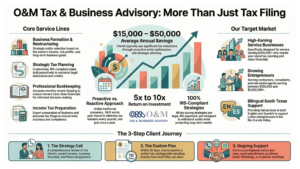
In working with business owners throughout the Rio Grande Valley, our Enrolled Agent team at O&M Tax & Business Advisory consistently identifies five structure mistakes that cost business owners the most money.
Mistake 1: Staying a Sole Proprietor Too Long
Most businesses start as sole proprietorships because it is the simplest structure to set up. But the threshold at which an S-Corp election becomes clearly beneficial is lower than most business owners realize — often between $40,000 and $60,000 in net annual profit, depending on the industry and individual circumstances. Business owners who earn above that threshold and remain as sole proprietors are paying thousands of dollars in excess self-employment taxes every single year.
Mistake 2: Forming an LLC Without Making the Right Tax Election
A Limited Liability Company is a legal structure, not a tax structure. An LLC can be taxed as a sole proprietorship, a partnership, an S-Corporation, or a C-Corporation — the choice is made by election with the IRS. Many business owners form an LLC, celebrate the “protection” they believe they have, and never make the tax election that would actually save them money. They pay the LLC filing fees, display the LLC designation on their business cards, and continue paying taxes as sole proprietors.
Mistake 3: Missing the S-Corp Election Deadline
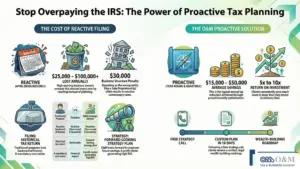
IRS Form 2553, the S-Corporation election, must be filed within specific timeframes. For a new business, it generally must be filed within 75 days of the formation date, or by March 15th of the following tax year. Missing this deadline means operating under the wrong tax structure for an entire additional year before the election can be made. For a business earning $300,000, that one missed deadline can cost $25,000 or more in preventable taxes.
Mistake 4: Setting the Wrong Reasonable Salary
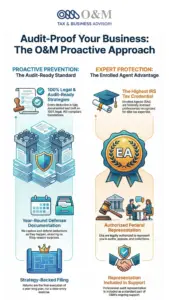
The S-Corp strategy requires that the owner-employee pay themselves a “reasonable salary” before taking distributions. The IRS scrutinizes businesses that set this salary artificially low — and the consequences of getting it wrong can include back taxes, penalties, and interest. Getting it right requires analysis of industry compensation standards, the owner’s actual role in the business, and the business’s overall profitability. Done correctly, this analysis identifies the salary level that maximizes savings while remaining fully defensible under IRS scrutiny.
Mistake 5: Not Revisiting the Structure as the Business Grows
A structure that was optimal at $150,000 in revenue may not be optimal at $500,000 in revenue. As businesses grow, as additional owners join, as the business diversifies into different activities, the optimal entity structure evolves. Business owners who set their structure once and never revisit it are almost always leaving money on the table by the time their revenue reaches meaningful levels.
Beyond Entity Structure: The Complete Wealth-Building Picture
Entity optimization is the foundation, but it is not the only tool available for building and protecting wealth through intelligent tax strategy.
Retirement Account Integration
A properly structured S-Corporation creates opportunities for significantly larger retirement contributions than a sole proprietor can make. A Solo 401(k) within an S-Corp structure allows business owners to contribute as both an employee and an employer — potentially sheltering $60,000 to $70,000 or more per year from current taxation, depending on age and income. Over a 20-year business career, this difference in retirement contribution capacity can represent hundreds of thousands of dollars in tax-deferred growth.
Qualified Business Income (QBI) Deduction
The Tax Cuts and Jobs Act created a 20% deduction on qualified business income for pass-through entities. This deduction is available to sole proprietors, S-Corp owners, partnership owners, and LLC members — but it has specific eligibility rules, income thresholds, and phase-out ranges that vary by industry. Optimizing for the QBI deduction requires active planning, not passive filing. Many business owners in South Texas qualify for this deduction and never receive it because their tax preparer does not plan for it proactively.
Asset Protection and Business Credit
The right entity structure does more than save taxes — it separates your personal assets from your business liabilities, establishes the foundation for business credit, and creates the legal and financial infrastructure that lenders, investors, and future buyers will require. For business owners who intend to grow, sell, or pass their business on to the next generation, getting the structure right from the beginning is foundational to those future outcomes.
How O&M Tax Approaches Entity Structuring
Our process at O&M Tax & Business Advisory begins with a comprehensive analysis of four factors: your current income, your industry, your liability exposure, and your long-term goals. These four factors together determine which entity structure creates the optimal combination of tax efficiency, legal protection, and operational simplicity for your specific situation.
Once the optimal structure is identified, we handle the implementation entirely. We prepare and file the formation documents, obtain the EIN directly through the IRS, draft the operating agreement, and file the S-Corp election with precision — on time, correctly, and in a format that will hold up under any IRS examination.
For business owners who are already operating under an existing structure, we conduct a full entity audit, identify the gap between where they are and where they should be, quantify the annual cost of that gap in real dollars, and restructure their business to capture the savings going forward.
Structuring Your Wealth Starts Today
The wealth you build from your business is not just about how much revenue you generate. It is about how much of that revenue you get to keep — after taxes, after expenses, after building the financial infrastructure that makes future growth possible.
Entity structure is the first and most powerful lever available to business owners who want to maximize what they keep. And for the vast majority of entrepreneurs across the Rio Grande Valley — in Edinburg, McAllen, Mission, Pharr, San Juan, Harlingen, and Brownsville — that lever has never been fully used.
The first step is a free strategy call. In 30 to 45 minutes, we will review your current structure, identify your specific savings opportunity, and show you exactly what a restructured business would save you annually.
The number is almost always larger than business owners expect.
Video Captions — Structuring Your Wealth: Strategic Tax Planning for Business Owners
The following are the full spoken captions from the O&M Tax & Business Advisory video “Structuring Your Wealth — Final Cut.”
The question most business owners never ask is this: how much of what I’m earning am I actually allowed to keep? Not what I made. What I get to keep after taxes, after self-employment taxes, after everything the IRS takes before I see a dollar.
If you’re operating as a sole proprietor and you’re making $200,000 a year, you’re paying self-employment tax on every single dollar of that profit. That’s roughly $28,000 — just in self-employment tax alone. But if you’re structured as an S-Corporation and you pay yourself a reasonable salary of $80,000, you only pay self-employment tax on that salary. The other $120,000 flows to you as a distribution — and that distribution is not subject to self-employment tax.
That’s $17,000 in savings. Per year. Legally. And it’s been available to you this entire time.
At O&M Tax and Business Advisory, entity structuring is one of the first things we address with every new client. Because if your foundation is wrong, everything built on top of it is going to cost you more than it should.
We help business owners in Edinburg, McAllen, Pharr, Mission, and the entire Rio Grande Valley set up the right entity, file the right elections, structure the right payroll, and build a financial foundation that actually works in their favor.
Enrolled Agents. Bilingual. Edinburg, Texas. And the first call is always free. Let’s talk about what you’re leaving on the table.